Memorial Day weekend and all the weekends that follow are busy times for lake country waters. We’d like to reshare the advice written by our 2022 Community Outreach Intern, Ava, on how we can all enjoy these beautiful waters while having a loon and lake friendly weekend.
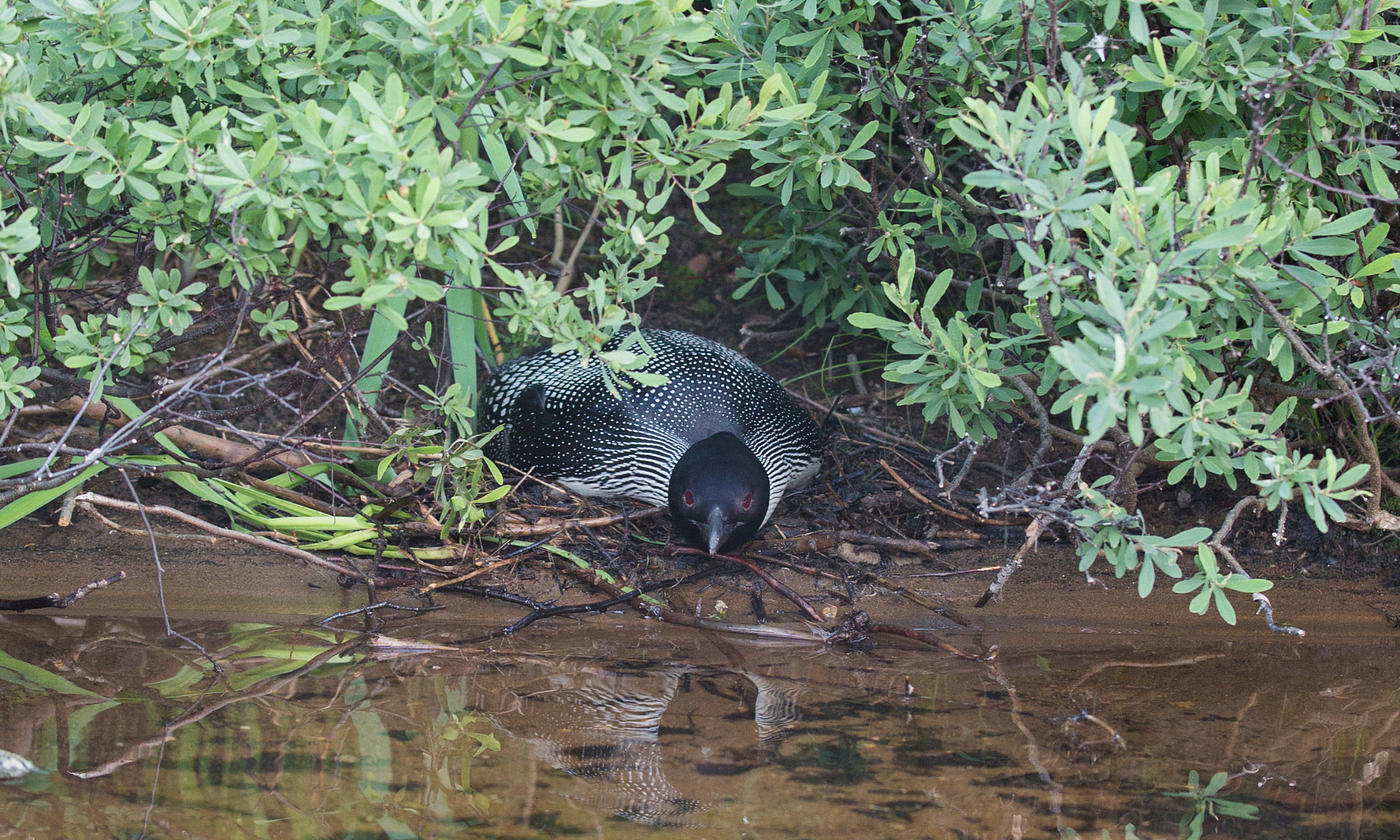
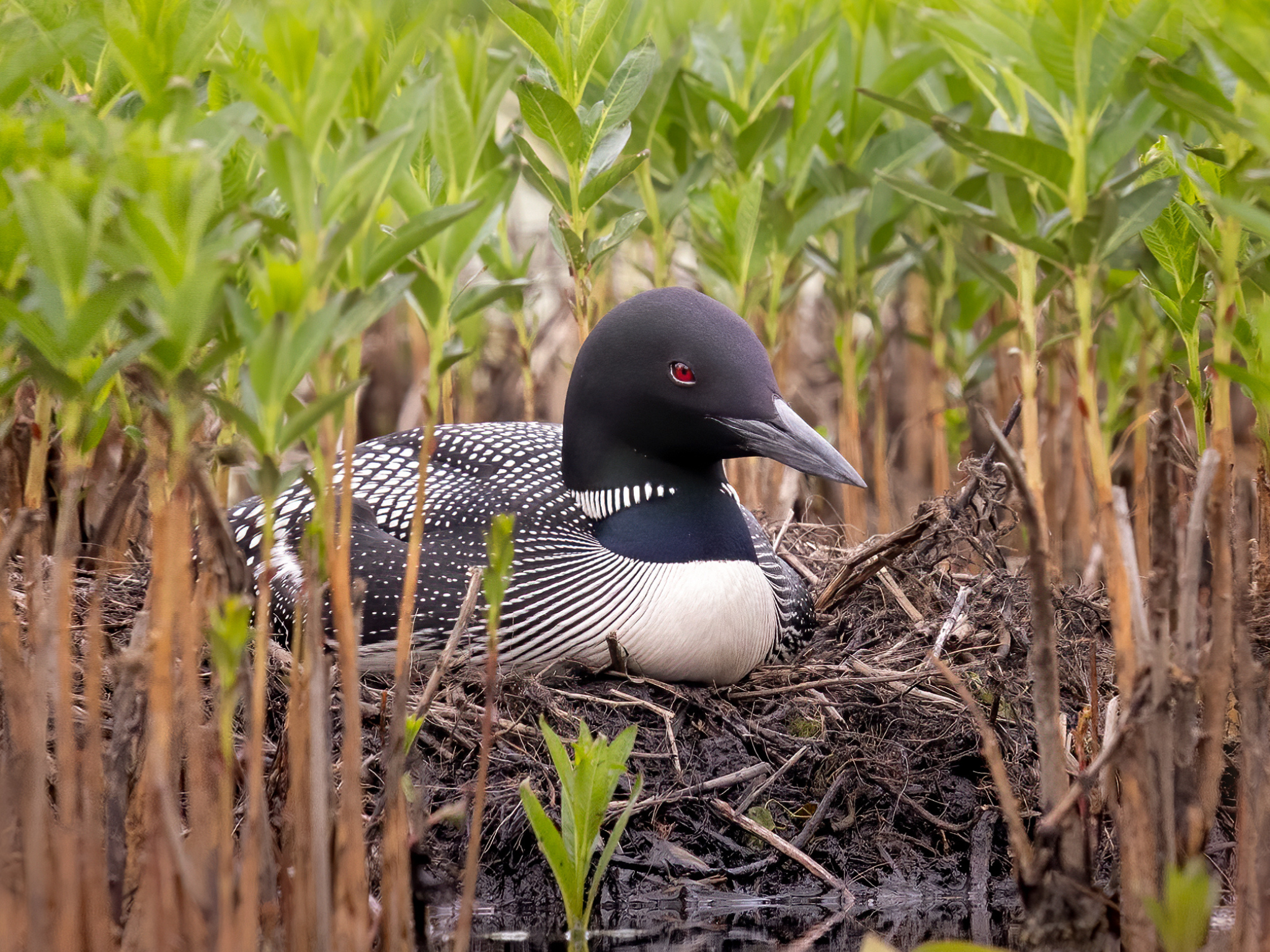
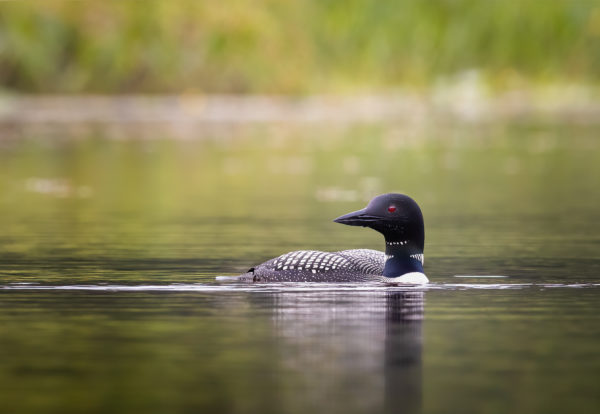
When taking your first step into the water, you may notice nesting loons near the shoreline. Adult Common Loons usually nest at the water’s edge of protected bays or small islands and once the eggs hatch, the small chicks are quite vulnerable. Staying at least 200 feet (the length of a standard ice hockey rink) from loon families, will give them enough space to remain undisturbed. While on a nest, a loon that feels threatened may flatten their body and neck over the water in the hangover position. Loons will do the penguin dance if they feel threatened, and seeing this display is a sign to back away. If you hear the tremolo of a loon, that is another warning sign that either you or a predator is too close to the loon or their chicks. Keep this knowledge in mind, and appreciate all wildlife from a non-intrusive distance.
This photo shows how loon nests may be well hidden and the defensive posture of the hangover position. Photo by mirceax from Getty Images.
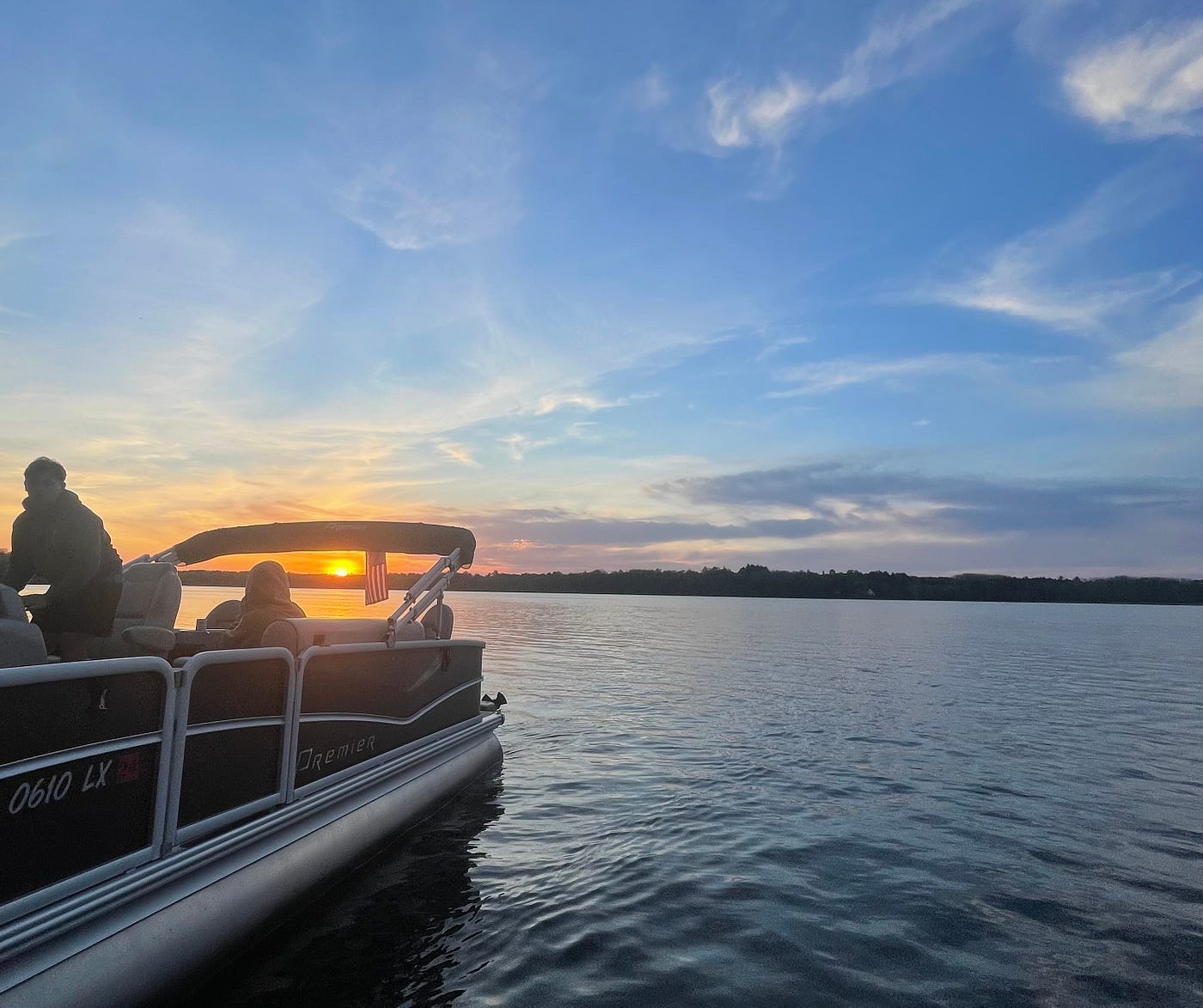
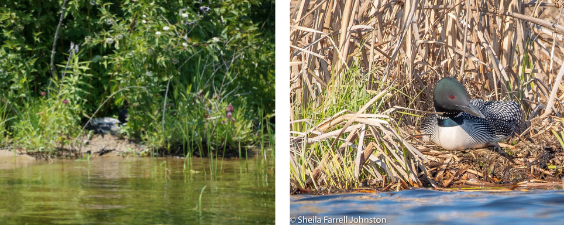
Cruising around the lake and reeling in fish is certainly part of the fun, but we can be careful in our actions. When out on the boat, keeping a slow speed and observing no wake zones near the shoreline protects the nests and homes of various wild animals, including loons. Wakes should be limited to open areas in the middle of large lakes. Additionally, all fast moving water crafts should always watch out for swimming and diving loons. In the summer of 2022, the National Loon Center recently received a call from a community member that found a deceased loon near shore. Ava brought the loon to the University of Minnesota Veterinary Diagnostic Laboratory for necropsy studies. The diagnosis came back that the likely cause of death was blunt force trauma to the head. We are not able to say for sure what could cause that, but we might guess that it would have been from a boat or jet ski collision. The National Loon Center began research on loon mortalities in 2021. Several of the necropsied loons so far have been diagnosed with blunt force trauma. To avoid facing similar situations going forward, water craft drivers should be mindful and attentive at all times.
Observe no wake zones to protect the shorelines, nesting loons, and young chicks. Photo by Sheila Farrell Johnston.
The necropsy studies have revealed other unfortunate outcomes for the loons. In the summer of 2021, a deceased loon was found and results indicated lead intoxication as the likely cause of death. Lost lead pieces at the bottom of a lake can be mistaken as a pebble by loons or loons may consume fish that carry lead jigs and sinkers. In each situation, the loon would most likely fatally suffer from lead poisoning. Thus, fishing lead-freeand keeping fishing lines out of the water when loons and other wildlife are nearby keeps all inhabitants of the lake safe.
Humans and wildlife alike depend on clean water to survive. Putting in effort to keep any pollutants and unnatural substances out of the water is important to keeps our lakes healthy. We recommend using rest facilities located on shore, not using soaps or shampoos in the lakes, and using trash containers on our boats and at our campsites. We encourage you to cleanyour watercraft and gear before leaving any water access or shoreland, taking special care to remove any aquatic plants, especially invasive specieslike zebra mussels. To ensure our kids will have healthy lakes to play in, and our loons and other wildlife will have a suitable habitat, we can start with keeping our waters clean today.
The lakes are a special place that we hope people will get to enjoy for generations to come. Thank you in advance for respecting freshwater ecosystems not only this upcoming weekend, but each day following. We want to keep the Common Loons common and we need your help. The magical call of the loon contributes to making your experience in the north woods so memorable- so join us in answering the call and protecting our loons long into the future.
Photo by Ava Rohleder
Wishing you all a safe and fun summer in the North Woods!
Putting my time interning at the National Loon Center into a few words is not easy. Throughout the summer, while explaining my role within the foundation to others, the most common response I received is “Wow, you are so lucky!” This is an understatement. Between the staff, research team, board members, volunteers, and the greater community of Crosslake, I have learned an incredible amount about how one great nonprofit organization is run, freshwater ecosystems, conservation and preservation in the Northwoods, and of course, the Common Loon. Thank you to everyone who has made these past few months immensely educational and enjoyable. I did not think I could love Northern Minnesota any more than I already did, but man was I wrong!
I am feeling exceptionally grateful as I leave the lakes region with connections and friendships, and I am already looking forward to visiting in the future. As I return to Loyola University Chicago and continue to make progress on my undergraduate degree in the School of Environmental Sustainability, I am inspired by the work that has been and is continuing to be accomplished at the National Loon Center. Special thanks to Jon, Natasha, and Mike for letting me be a part of something so special.
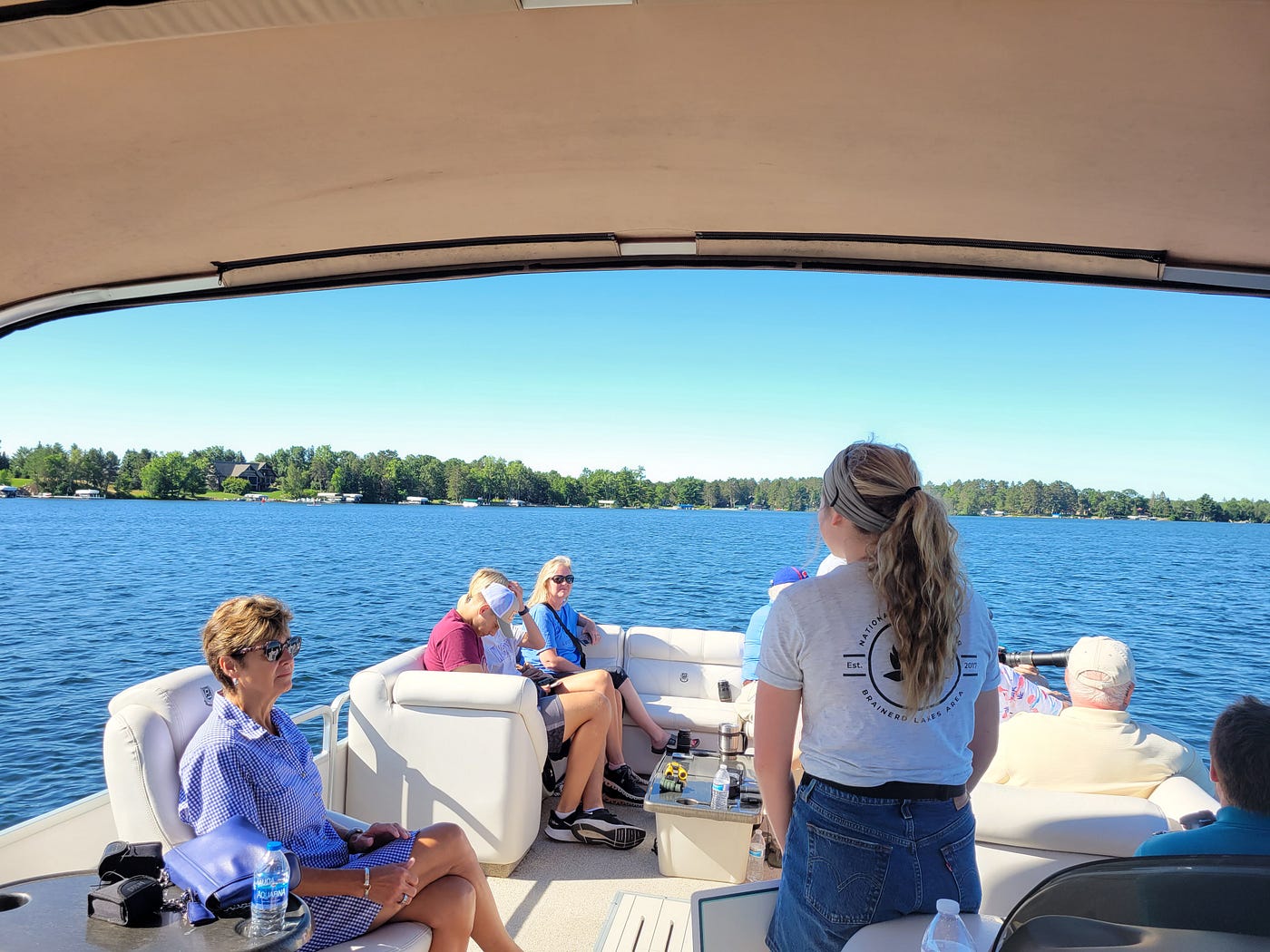
Ava leading a tour aboard the National Loon Center’s StewardShip
By Ava Rohleder, Community Outreach Intern, National Loon Center
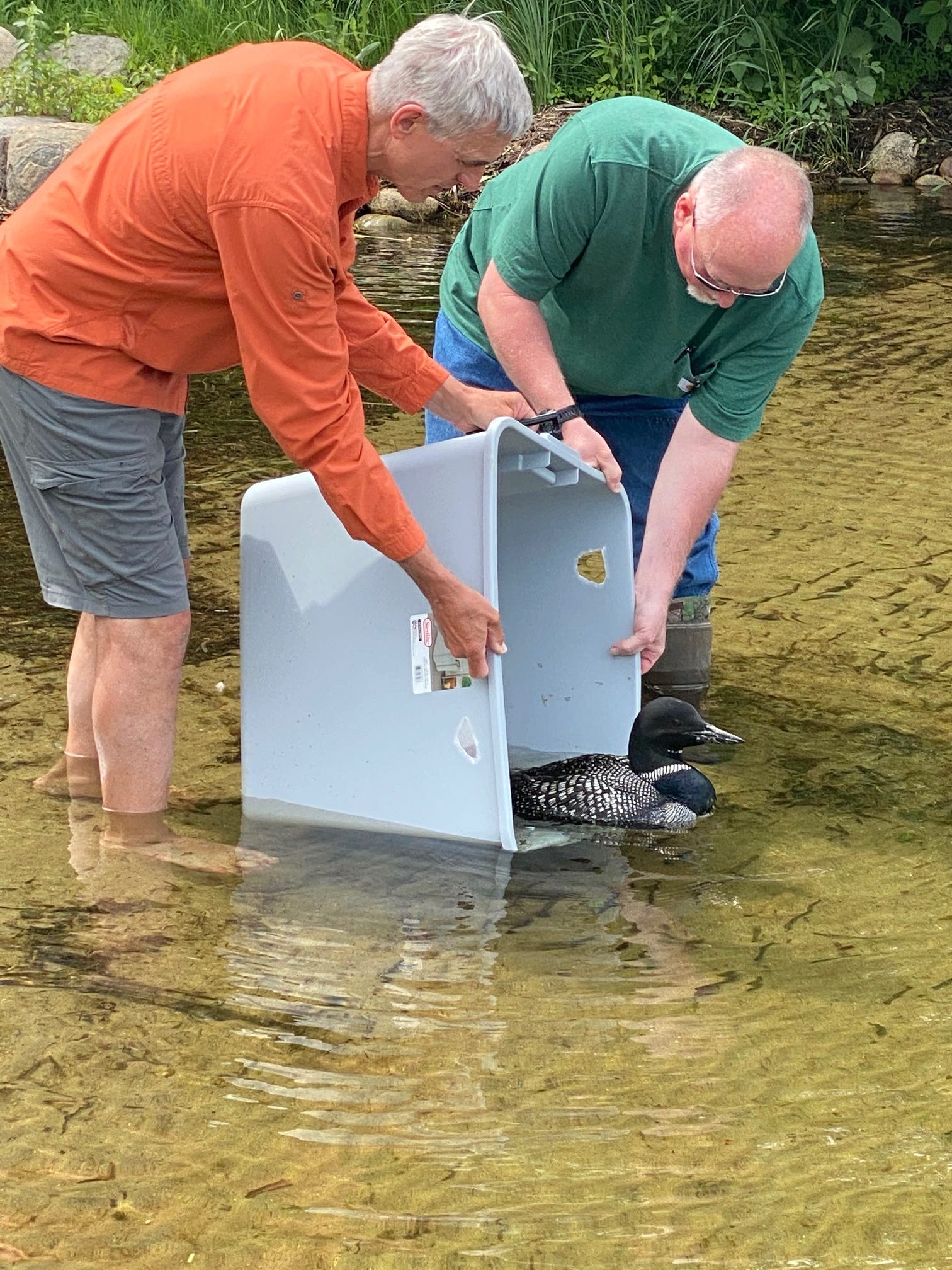
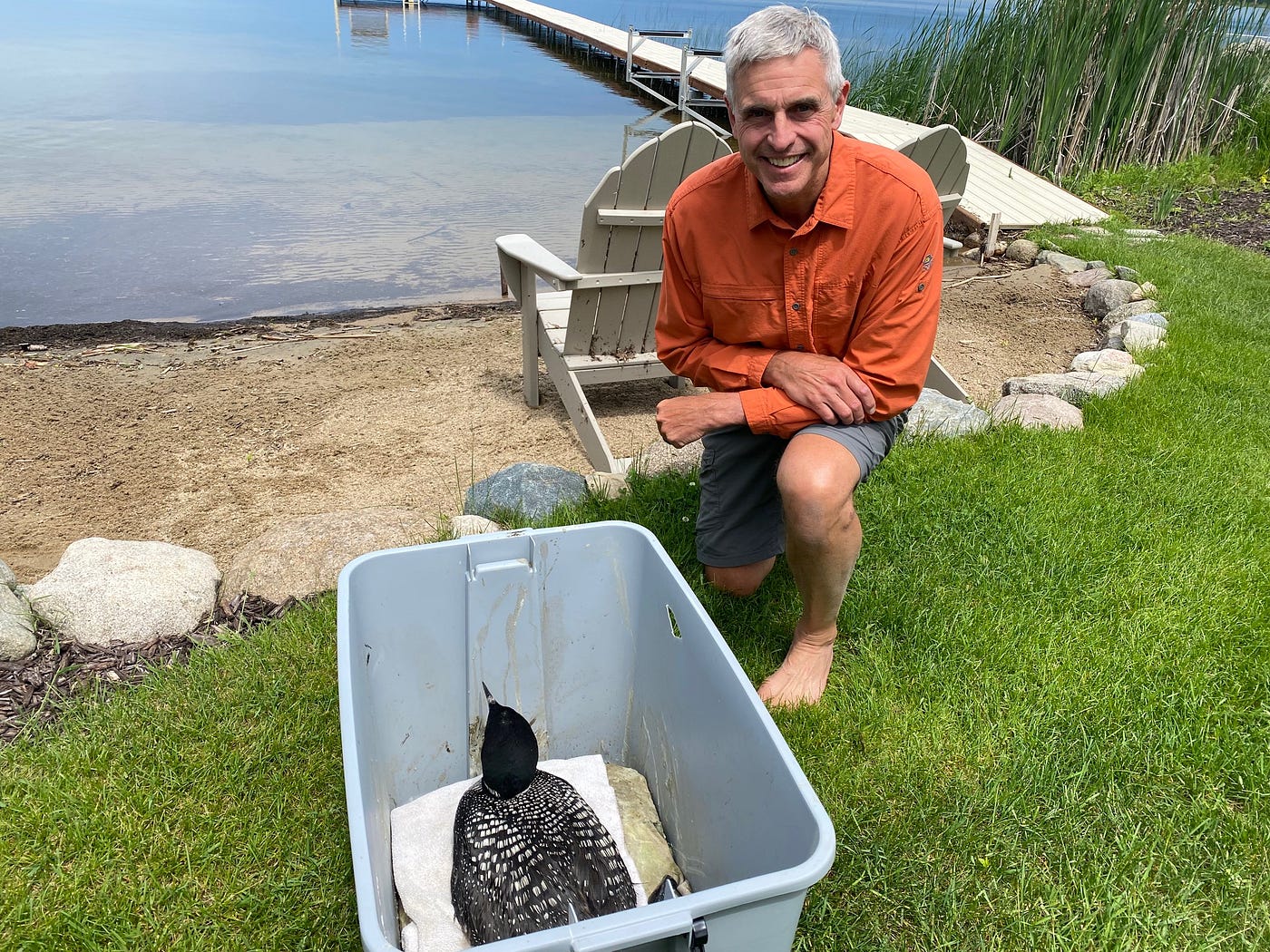
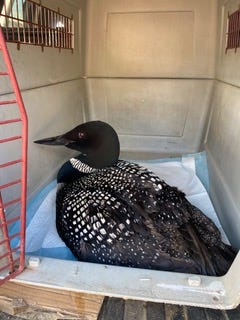
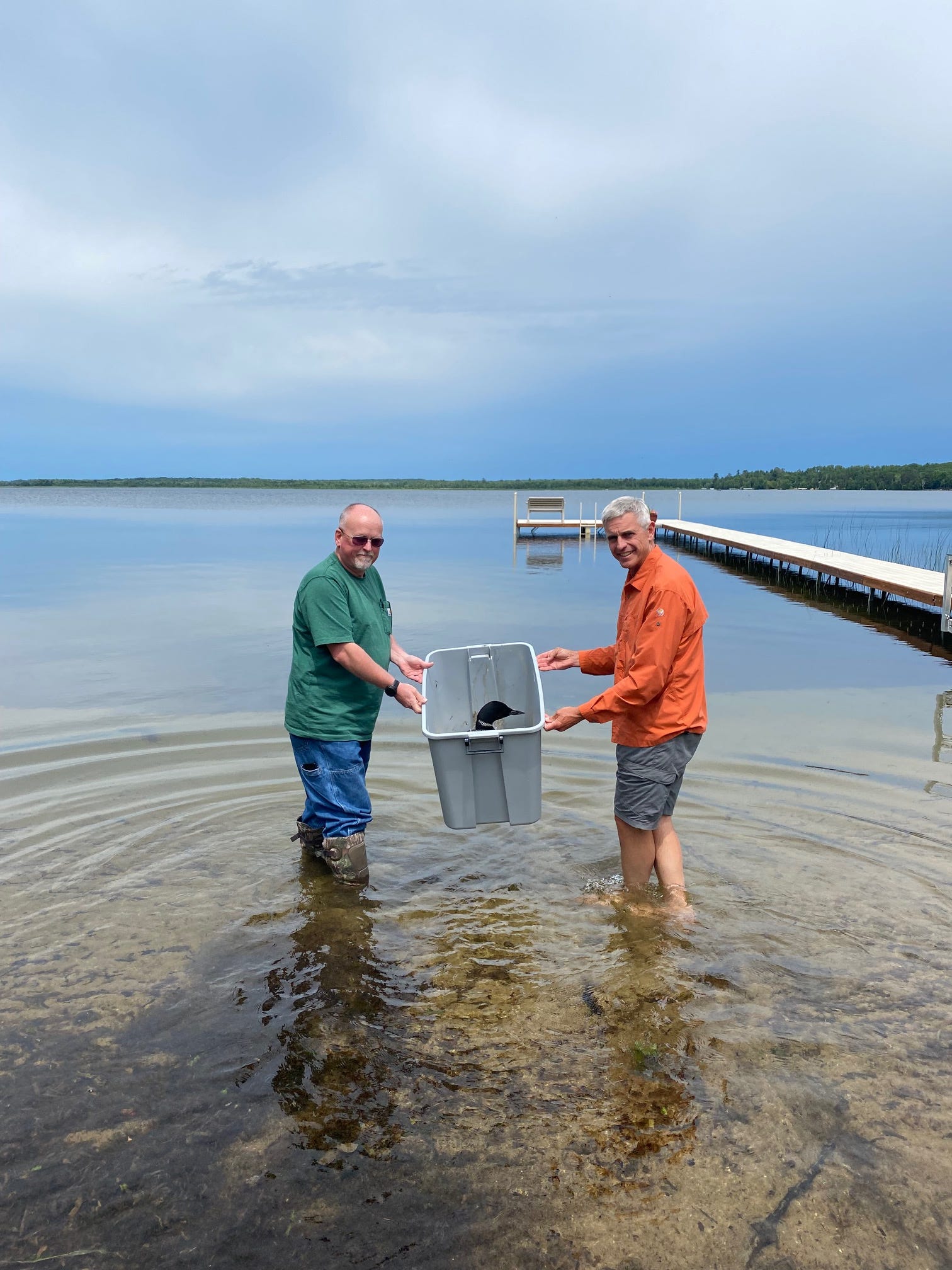
The National Loon Center received a call on June 21st from a caring Minnesotan in Walker, MN who found a Common Loon “resting” on a Leech Lake shoreline. After observing the bird for several hours, Chip Leer determined that something was amiss. Leer, a National Loon Center board member and renowned outdoor lifestyle guide, was kind enough to share his loon rescue story with us.
“After returning home from a weekend away at a family wedding we noticed a loon on the shoreline. Not that loons are uncommon on Kabekona Bay of Leech Lake, they are not — we purposefully leave windows open at night so we can hear them communicate as it brings us peace. I suppose if we were land lovers we might like the sound of a rooster at 4 a.m., but we’re lake people and prefer the loon 24/7.We noticed that this loon was actually quite a ways out of the water on our small beach and that was unique. It also was odd that it never moved, not an inch. Eventually we witnessed other birds flying by and natural activity taking place, yet still the loon never moved, only to flatten itself as if to stay concealed. We also noticed that the bird appeared tired; its head bobbed as if it was trying not to fall asleep. Initially we avoided the bird hoping it might go away, it didn’t. Then we decided to water some planters lakeside which during any normal wildlife interaction would cause the loon to vacate immediately, but it did not. It was then we decided to make some inquiries.
Photo by Chip Leer
We first called the National Loon Center as a recent newsletter had suggested, and then reached out to various MN DNR offices including our local conservation officer. No luck there as he was on a nuisance bear call and unavailable. Finally, Jon Mobeck, Executive Director of the National Loon Center, and a good personal friend Joe Carlson of Nevis, MN sent contact information almost simultaneously for Julie at Northwoods Wildlife Rescue. Julie phoned and had a number of questions of which she accessed the bird’s health. From that information, she asked, “How adventurous are you?” I replied, “Somewhat, what’s your thought?” She provided detailed instruction on how to capture and transport the bird, and it came together just as she described. She informed us she didn’t have time to come all the way to us as she is currently caring for dozens of baby wild birds/animals at the moment she couldn’t leave for long but would meet us about 30 minutes away. 24/7 those babies were her responsibility. We followed her instructions for capture that included a fishing net, gloves, long sleeves, eye protection and approach angles. We captured the bird without incident and never felt as if we were providing any harm to the bird, it was also apparent the bird was very tired, not much of a struggle. A few pecks to the gloves, but no worries. We transferred the bird to a cardboard box, covered it with a towel and drove 30 minutes to meet with Julie.
Photo by Chip Leer
In summary, we were a bit timid on capturing the bird as we did not want to do it any harm and certainly didn’t want to get hurt in the process, after all this is a wild animal. Julie’s detailed instruction and calm demeanor helped us make and execute a plan that was flawless.”
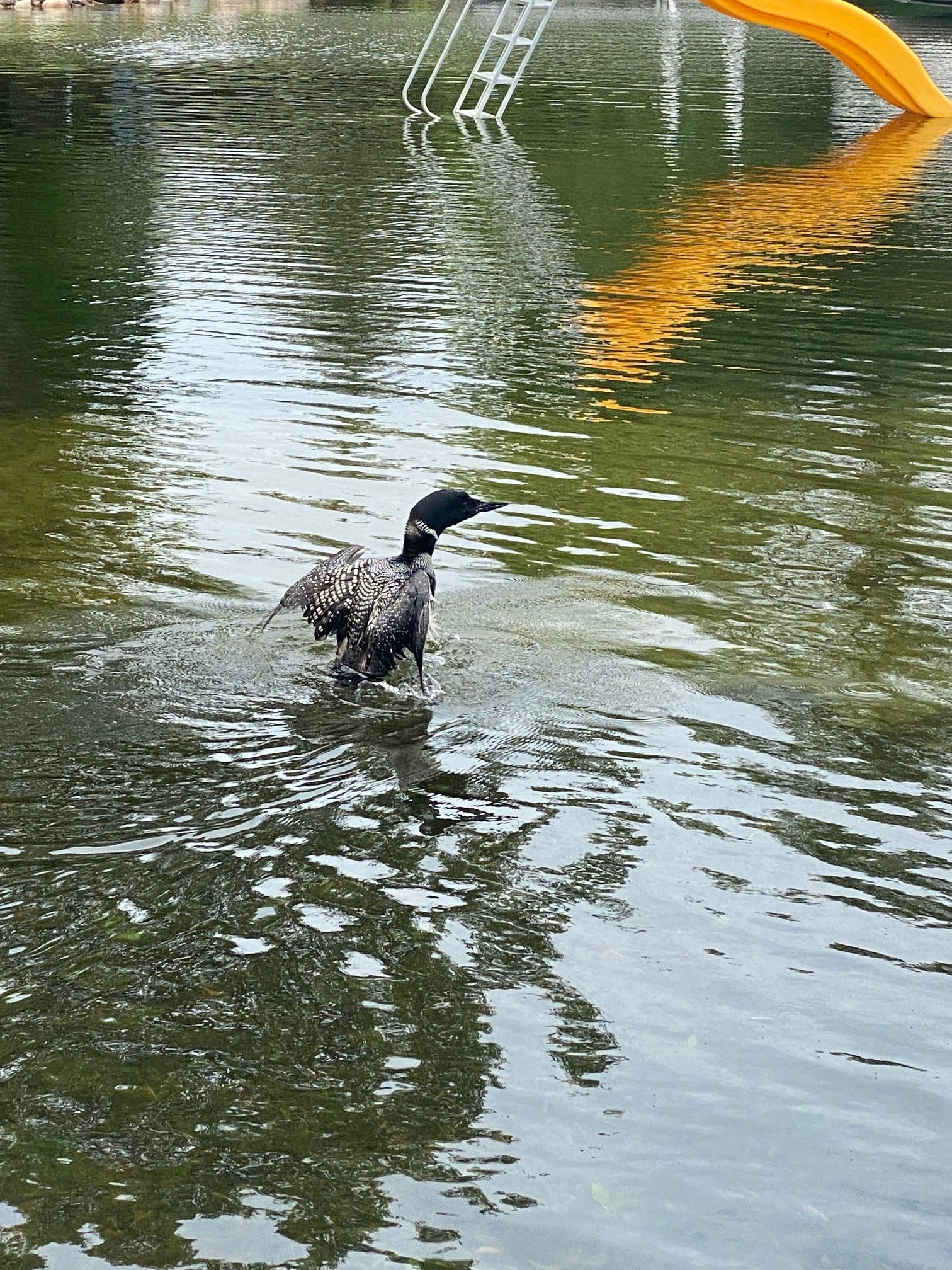
As of today, the bird is released and doing well after it spent time at both Northwoods Wildlife Rescue and Wild & Free wildlife rehab center. We’ve received updates that the loon had no external injuries visible. The loon had a good first night, ate well in the morning, and was excreting well. The loon’s blood was tested to see if there were any internal problems, and weight and bloodwork results came back excellent.
The wildlife rehabilitators’ best guess is that the loon was chased on shore in a territory dispute. It may have lost a little spat and just been exhausted. The rest and plentiful food seem to have served it well, and now the loon is free.
The National Loon Center is grateful to have such dedicated members, like Chip, on our board. In this case, the abnormal behavior of the loon was good cause to intervene and contact both the NLC and a wildlife professional. Lethargy and unusual behavior could be a sign of lead poisoning. This is a fortunate situation where we discovered the loon appeared to be recovering from an injury and was releasable. Although, in the event of a known territorial dispute of loons we may not necessarily intervene as these are natural occurrences in the lives of loons.
The National Loon Center is grateful to continue to work with organizations such as Wildlife Rehabilitation & Release and the University of Minnesota Raptor Center’s Partners for Wildlife program as well as DNR permitted wildlife rehabilitators in statewide wildlife rescue efforts.
By Ava Rohleder, Community Outreach Intern, National Loon Center
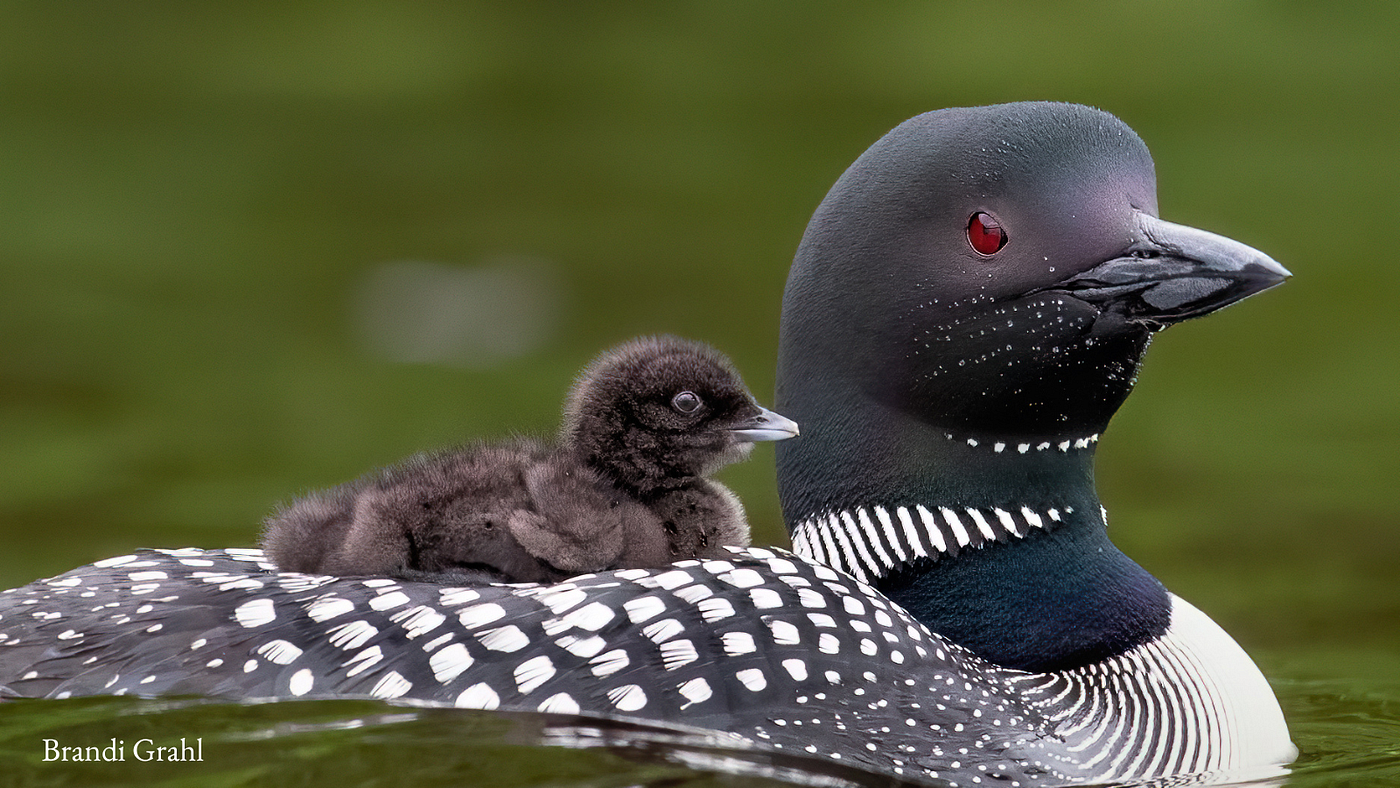
Photo by Brandi Grahl
A big weekend for our lake country waters is approaching: The 4th of July. This federal holiday prompts folks to get together with friends and family to spend time playing cards in cabins, by the shore circled around a bonfire, and of course, out on the lake swimming, boating, fishing, and canoeing, from sun rise to sun set. While participating in fun summertime activities, we must keep in mind that we are visitors on these precious waters. I would like to share tips on behalf of the National Loon Center in hopes we can collectively have a loon and lake friendly holiday weekend.
When taking your first step into the water, you may notice nesting loons near the shoreline. Adult Common Loons usually nest along the protected areas on freshwater lakes and once the eggs hatch, the small chicks are quite vulnerable. Staying at least 200 feet from loon families, will give them enough space to remain undisturbed. Loons will do the penguin dance if they feel threatened, and seeing this display is a sign to back away. If you hear the tremolo of a loon, that is another warning sign that either you or a predator is too close to the loon or their chicks. Keep this knowledge in mind, and appreciate all wildlife from a non-intrusive distance.
Cruising around the lake and reeling in fish is certainly part of the fun, but we can be careful in our actions. When out on the boat, keeping a slow speed near the shoreline protects the nests and homes of various wild animals, including loons. Wakes should be limited to open areas in the middle of large lakes. Additionally, all fast moving water crafts should always watch out for swimming and diving loons. The National Loon Center recently received a call from a community member that found a deceased loon near shore. I brought the loon to the University of Minnesota Veterinary Diagnostic Laboratory for necropsy studies. The diagnosis came back that the likely cause of death was blunt force trauma to the head. We are not able to say for sure what could cause that, but we might guess that it would have been from a boat or jet ski collision. The National Loon Center began research on loon mortalities in 2021. Last year, one of the necropsied loons was also diagnosed with blunt force trauma. To avoid facing similar situations going forward, water craft drivers should be mindful and attentive at all times.
The necropsy studies have revealed other unfortunate outcomes for the loons. Last summer, at Big Lake Resort, a deceased loon was found and results indicated lead intoxication as the likely cause of death. Lost lead pieces at the bottom of a lake can be mistaken as a pebble by loons or loons may consume fish that carry lead jigs and sinkers. In each situation, the loon would most likely fatally suffer from lead poisoning. Thus, fishing lead-freeand keeping fishing lines out of the water when loons and other wildlife are nearby keeps all inhabitants of the lake safe.
Humans and wildlife alike depend on clean water to survive. Putting in effort to keep any pollutants and unnatural substances out of the water is important to keeps our lakes healthy. We recommend using rest facilities located on shore, not using soaps or shampoos in the lakes, and using trash containers on our boats and at our campsites. We encourage you to cleanyour watercraft and gear before leaving any water access or shoreland, taking special care to remove any aquatic plants, especially invasive specieslike zebra mussels. To ensure our kids will have healthy lakes to play in, and our loons and other wildlife will have a suitable habitat, we can start with keeping our waters clean today.
The lakes are a special place that we hope people will get to enjoy on the 4th of July weekend for generations to come. Thank you in advance for respecting freshwater ecosystems not only this upcoming weekend, but each day following. We want to keep the Common Loons common and we need your help. The magical call of the loon contributes to making your experience in the north woods so memorable- so join us in answering the call and protecting our loons long into the future.
By Emma Weber, National Loon Center & Loon Project Research Intern
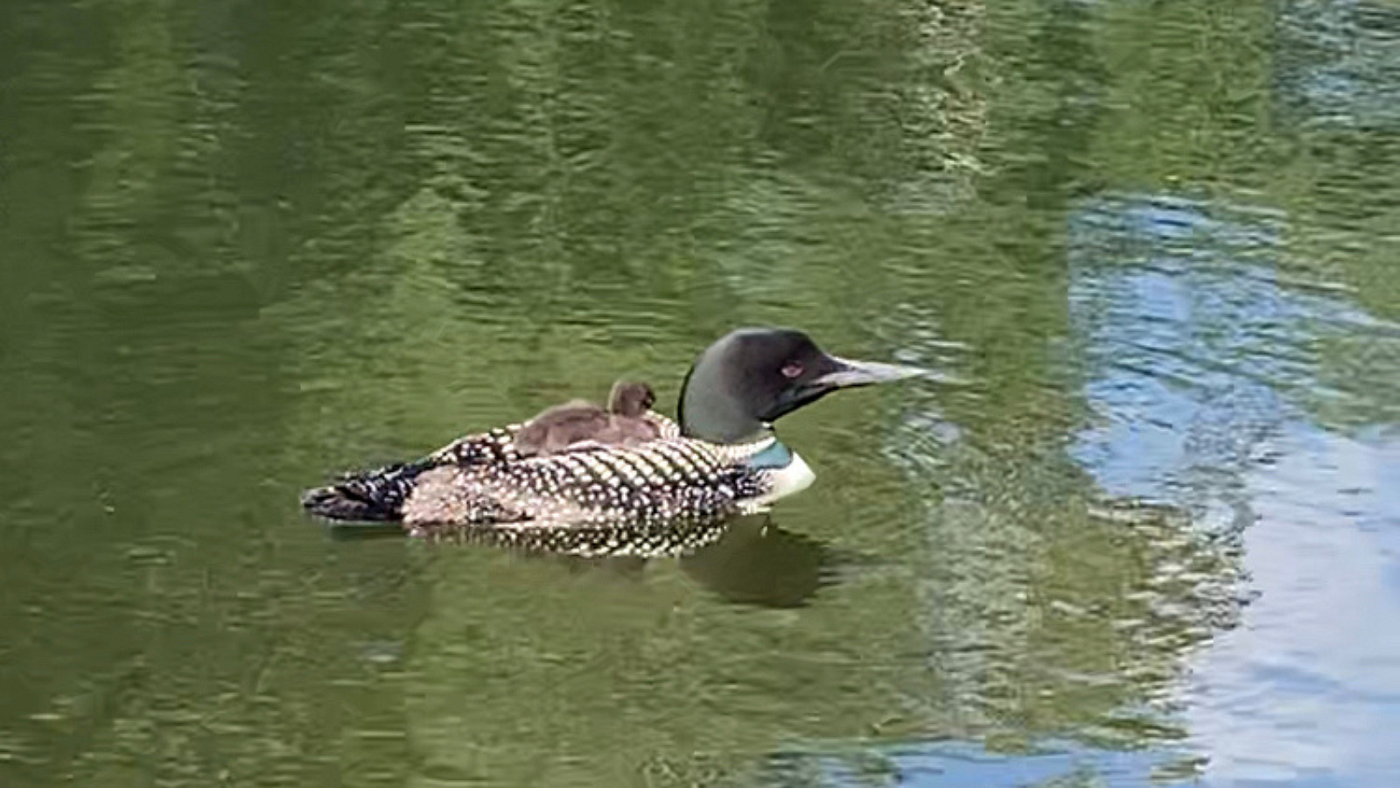
As summer begins, many of the loon pairs in our study area can be seen with chicks riding on their backs or trailing them in the water. This week, I checked some territories on the Whitefish Chain with Emily (another research intern) and Mike (Program and Operations Associate for the NLC), and we were excited to find eight pairs on Cross and Rush lakes with either one or two chicks.
Photos from the field: a loon is spotted by the research team with a chick on its back
This brought the grand total this season to 19 sighted chicks, although hopefully the number will quickly rise as we continue to revisit lakes. When observing chicks, it’s always interesting to see them practice behaviors such as preening, “foot waggling,” and flapping their tiny wings. My favorite part, though, is watching how chicks interact with their parents.
A family of loons on Eagle Lake spent time together while I visited last weekend. One chick stayed on the parent’s back while the other alternated between floating in the water and laboriously climbing back up to sit beside its sibling, despite being so small that it was probably only a few days old. When the mate returned from foraging with some fish for the chicks, both chicks happened to be on the back of the resting parent. Seeing the food, the active chick quickly leaped into the water, which earned it a call from the parent that seemed to say, “I told you not to do that!”
Video of a loon pair with its chick on Rush Lake by Emma Weber
I’ve also learned that not all parents stay constantly close to their young. During an intense interaction with an intruding loon (a loon that enters a pair’s territory to compete with a pair member), a couple of parents on Rush Lake left their chick floating in the water near some boat docks while they dealt with the intruder much farther offshore. Once I noticed the chick sitting in open water, I was anxious for the parents to return to it. I couldn’t help but think of all the different predators on the lakes that would gladly make lunch out of a small chick- eagles, ospreys, large fish, and snapping turtles come to mind. However, the parents had the situation under control; soon, the intruder fled, and they returned to their chick.
While several pairs have hatched their chicks, some laid clutches of eggs later and continue to incubate. As the season progresses, we will keep an eye out for failed nests while hoping that the next time we visit each incubating pair, we can experience the excitement of finding one or two new chicks.
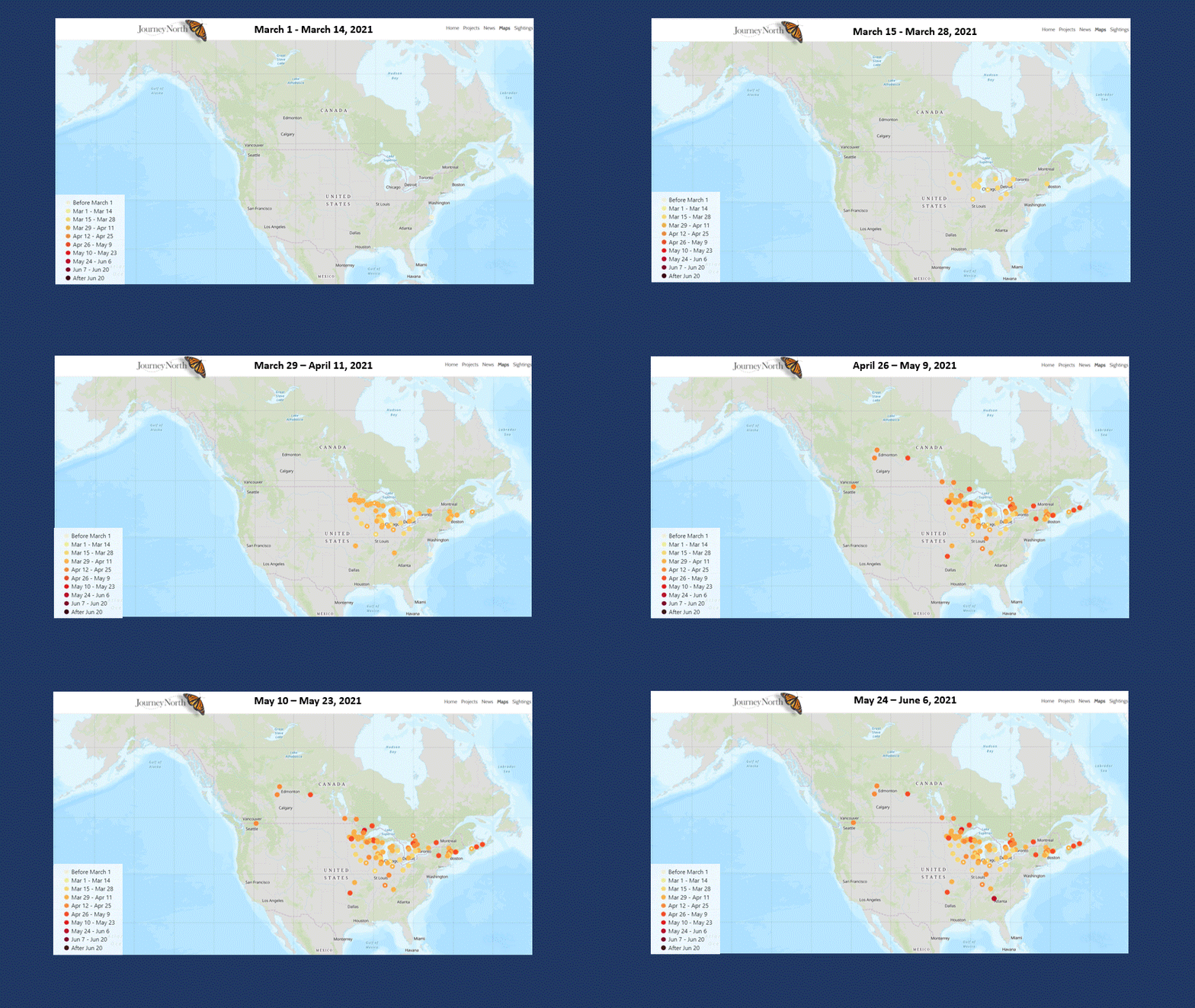
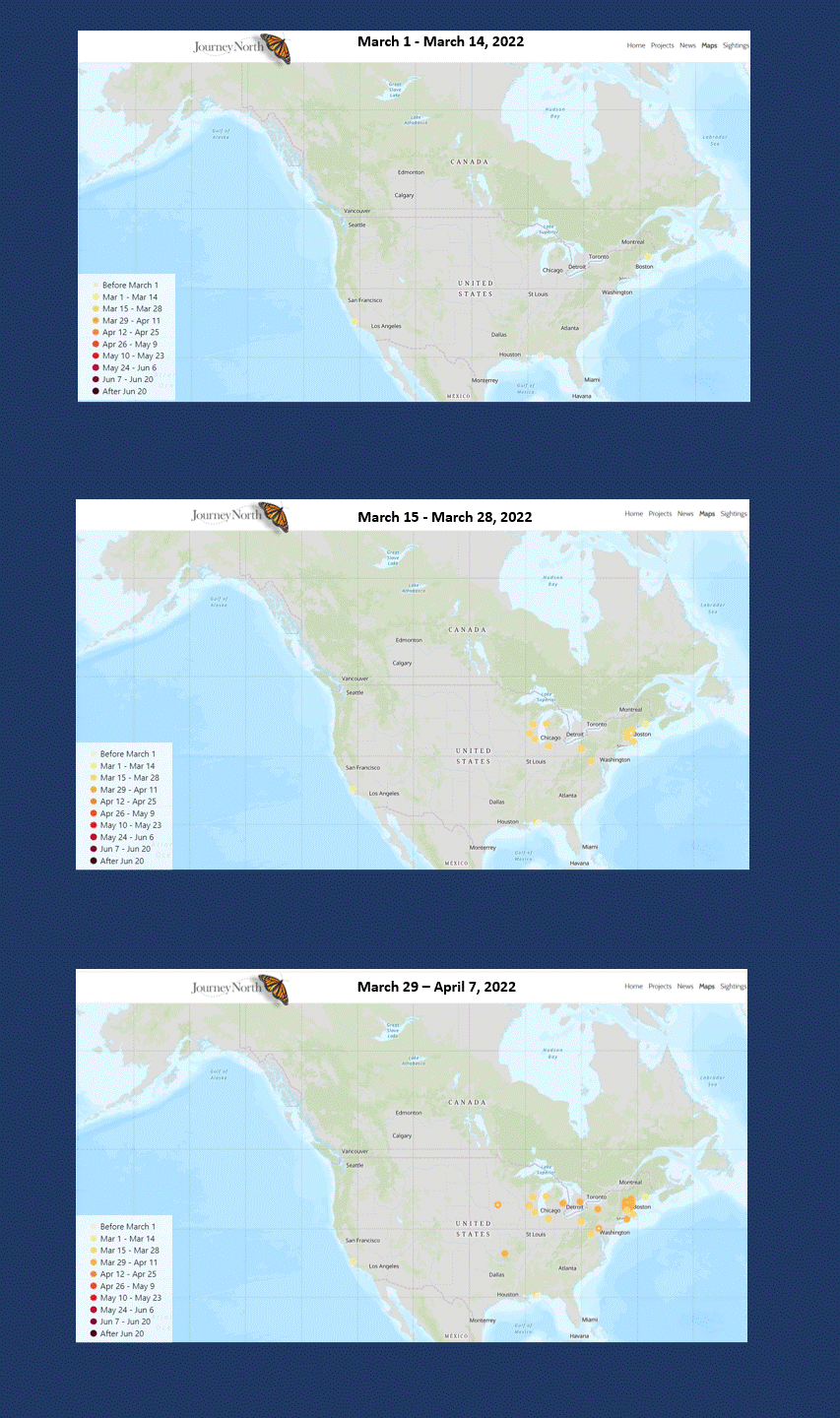
The National Loon Center began a long-term research study of the Minnesota common loon population in 2021. You too can contribute to loon research by documenting loon sightings in your “backyard” through community science projects. In fact, April is Citizen Science Month! As this time of year is the spring migration of common loons, we’ll focus on the migration project, Journey North. There is also iNaturalist and eBird, which are global databases that you can use on a desktop or mobile device. Let’s learn more about each project below:
Loon Migration: Journey North
Journey North tracks migration and seasonal changes across North America. The common loon study relies on individuals to report their first sightings of loons and the dates of ice-out on lakes. Learn more from Program Coordinator, Nancy Sheehan, about Journey North below:
What is Journey North and how does it work?
“Journey North is a crowdsourced, citizen science program of the University of Wisconsin, Madison Arboretum. Begun in 1993, Journey North has engaged a wide audience across North America in tracking the migration of many different species, including monarch butterflies, six species of hummingbirds, red-winged blackbirds, barn swallows, Baltimore and Bullock’s orioles, American robins and, of course, common loons. Because many of these migratory species travel thousands of miles each year, Journey North needs a crowd to capture the action. From Canada, the U.S., Mexico and beyond, we need your help. Every observation counts. All that is needed is an observant eye and 15 minutes to enter the data online.
Whether you submit observational reports or not, you can watch migration unfold on Journey North’s many migration maps or follow along by reading our weekly news updates.”
Migration map of first sightings of common loons in 2021
2. Why study migration and seasonal changes?
“About 350 (or about 15%) of all bird species in North America are migratory. (eBird) The estimate for insects is about 71 migratory insects. (NWF) Few people are aware of these incredible journeys. Migration stories are amazing stories about survival and resilience and can be truly inspiring to learn about. Beyond these stories being inspirational, it is also imperative to know more about migration. Many migratory birds and insects are in decline. By becoming a volunteer with Journey North, you not only contribute data to migration science, you become a local expert who can tell the migration story to others. You will also become more “in the know” about habitat needs of migratory species. Migratory species need access to food and shelter all along their migration routes — both in the spring and in the fall. By tracking migration, you contribute information that can indicate where habitat is most needed for migratory species. Your observational reports help us all visualize where critical migration corridors link breeding and non-breeding ranges. While our migration tracking and habitat conservation work may be local, our collective impact will be continental.”
3. How do I submit my first sightings of common loons? Can I include loons that are “stopping by”?
“To submit an observational report, you must first set up an account with Journey North. This is an easy, three-step process. Go to our registration page to learn more.
After you have registered, you are ready to submit an observational report. Journey North asks for the date, location, and number of species observed. A photograph can accompany an observational report. Comments are welcome too! With drop down menus and straightforward information fields, report submission is a quick process. You will need to have access to the internet. Go to our sightings page to learn more.
For the Journey North Common Loon Project, we ask you to submit when you observed your first loon in spring (anytime between January and June). We also ask you to enter data on ice-out dates. For Journey North, it’s all about the journey, not only the destination. Please tell us when you see a common loon regardless of whether you report from a destination/breeding lake or at a stop-over waterbody.”
First sightings of common loons as of April 7, 2022
4. What can we learn from comparing year-to-year ice out dates?
“Even though we have learned much about wildlife migration, there is still so much to learn. For example, we are not entirely sure how animals and insects know when and where to migrate, especially if they have never been to their breeding or non-breeding ranges. Another big question is how climate change is impacting migration. For example, common loons need open water to land and take off during spring migration. But are lakes, ponds and other waterbodies “open” when loons need them that open water? Tracking ice-out dates over many years can contribute to understanding the impact of climate change on loon migration, answering this and many other questions.”
iNaturalist is one of the most widely used nature apps out there and tracks biodiversity across the globe. iNaturalist relies on community observers to ID observations of flora and fauna. If you have a photo of a common loon and remember the date, time, and location where you took the picture, then you can upload via your desktop. Or, download the iNaturalist app on your phone to submit observations in real time — the date, time, and location will be automatically recorded.
A unique, though morbid, feature of iNaturalist is that observers can submit photos of living or deceased animals. Photos of deceased animals can help scientists study mortality, especially if there is evidence of how the animal may have died.
Perhaps for the more advanced user, eBird allows you to submit checklists of the species you see and hear while out birding. We’ll dub looking for loons during your outing “looning.” Although, you will need to record all species of birds you come across to submit a complete checklist. eBird is more advanced as you keep track of the number of each species of bird you see over a certain time period, taking care not to double count birds. You can record your checklist on paper and submit it via your desktop when you return home or do so directly from the eBird app on your phone.
Using the eBird website from your computer gives you access to species and region maps where you can see the distribution of birds across a geographic range or look for birding hotspots.
The National Loon Center arose as an ambitious idea proposed by citizens of Crosslake, Minnesota in 2016. In the formative years since, our founders and board of directors have worked passionately to move the vision for a world-class educational facility toward reality.
With the invaluable help of countless community supporters, tireless researchers, and dedicated volunteers, the National Loon Center achieved many goals in 2021 to have one loon of a year!
1. May 2021: Facilitated research on loon mortality
To better prevent loon mortality, we need to understand why loons die. The NLC obtained state and federal migratory bird permits to transport deceased loons found on Minnesota lakes to Dr. Arno Wuenschmann, professor of Veterinary Pathology at the University of Minnesota Veterinary Diagnostic Laboratory, who performed the loon necropsy studies. Sadly, we found that loons had perished from lead poisoning, gun shots, and probable collisions with boats or jet skis.
2. May 2021: Protected critical loon nesting habitat in Fifty Lakes, MN
With funding from the Outdoor Heritage Fund and additional support from the Fifty Lakes Fire Relief Association, the NLC acquired approximately 6 acres of land with over 2,500 feet of shoreline in Fifty Lakes. This land consists of largely undisturbed aquatic and riparian habitat that supports nesting loons and other wildlife. The pristine lakes that are protected in part by the acquired land are among the most significant loon nesting areas in the region, with at least 7 pairs of loons occupying the lakes; two of which nest in the bays directly alongside the NLC’s newly purchased land.
3. June 2021: Opened The Nest
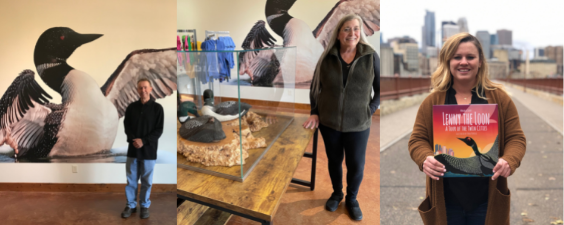
Before our state-of-the-art facility opens in 2024, we will engage and educate the public at a visitor center in Crosslake Town Square called The Nest. The Nest has already expanded awareness considerably, bringing in more than 4,000 visitors from June through November to learn about loons, lakes, and the NLC. This prominent storefront location enabled the NLC to showcase the forthcoming world-class facility, highlight its current programs and outreach efforts, and significantly expand its network of supporters and donors — critical for long-term operational sustainability. The Nest fosters community connections and hosts a mural by local wildlife photographer, Mark Harlow, realistic loon wood carvings by Laurie J. McNeil, and the Lenny the Loon book series by Mikaela Casey. We also had fun hosting an inaugural loon calling competition at the Town Square in September.
From left, Mark Harlow, Laurie J. McNeil, and Mikaela Casey
4. June 2021: Engaged in statewide partnerships
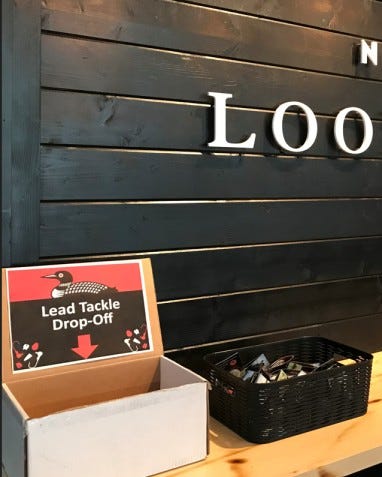
Our conservation efforts are elevated by the partnerships we’ve formed across Minnesota and the country. We are proud to join the Minnesota Department of Natural Resources and the Minnesota Pollution Control Agency in advancing the Get the Lead Out program. We delivered presentations to dozens of lake associations and community groups this summer as well as hosting a lead tackle drop off site at The Nest, which also provided visitors with free nontoxic tackle samples. We are also pleased to work with companies who prioritize conservation ethics in their business models, such as Velaasa. This year, Velaasa released a special loon edition of their Raptor athletic shoes that sends a donation towards the NLC with each pair sold.
Get National Loon Center’s stories in your inbox
Join Medium for free to get updates from this writer.Subscribe
Remember me for faster sign in
5. August 2021: Received grants to launch the Floating Classroom
A grant from the Crosslake Ideal Lions Club helped support the launch of the Floating Classroom education program and allowed the NLC to purchase a 31′ tri-toon boat. Participants will see loons from a respectful distance and learn about loon and freshwater ecology through hands-on scientific projects. A curriculum for a two-hour, on-the-lake educational program was designed with assistance from University of Minnesota graduate students. An additional grant from the Land & Waters Preservation Trust enabled the NLC to purchase water testing equipment, sample kits, and safety and mooring equipment.
6. November 2021: Hired two additional staff members
Our accomplishments this summer could not have been possible without the help and support of our wonderful volunteers and board members. The NLC was excited to add to its staff by hiring Natasha Bartolotta as the Communications and Outreach Coordinator and Mike Pluimer as the Program Operations Associate. From the establishment of The Hoot e-newsletter to the creation of an array of top-notch educational materials, Natasha and Mike have already made significant contributions to the organization.
7. November 2021: Began site enhancements at NLC’s future home
Our world-class facility will open in 2024 at the U.S. Army Corps of Engineers — Cross Lake Recreation Area in Crosslake, MN. We are thankful to our lead architectural and engineering partner, Widseth, and MN Boardwalks for the completion of sidewalks, boardwalks, and floating mooring stations. These stations will provide safe lake access to the recreating public and NLC visitors while protecting the shoreline from erosion. These improvements are made possible by the Minnesota Environment & Natural Resources Trust Fund. Additional site enhancements are forthcoming, as NLC also worked with Widseth to create outdoor exhibits featuring interactive video content and infographics that are set to be installed at the site in the spring of 2022.
8. November 2021: Completed shoreline restoration project
Shoreline along Cross Lake near the popular campground has degraded over decades due to heavy boat and foot traffic. Native vegetation has been planted to restore and maintain the shoreline ecosystem, providing habitat for native species to return. The restoration effort also anticipated visitor needs and the boardwalks and mooring stations are designed to improve the visitor experience while protecting the shoreline.
9. December 2021: Coordinated with DNR and fire department on loon rescue
After receiving a tip from local photographer, Mark Harlow, that a loon might be iced-in on Cross Lake, the National Loon Center engaged regional winter rescue experts as well as the Minnesota DNR and Crosslake Volunteer Fire Department to consider a rescue attempt. The Crosslake Fire Department ultimately captured the iced-in loon and it was transported to the Wild and Free wildlife rehab center in Garrison, MN for examination. Unfortunately, the loon had an untreatable wing injury likely resulting from a boat strike. With significant media attention surrounding loon rescues in northern Minnesota, the National Loon Center wrote a comprehensive and well-received educational piece on the complexities of loon rescues. The Cross Lake loon brought awareness towards safe boating practices and loon protection efforts. With many state and national partners, we aim to connect and strengthen loon rescue and rehab networks in 2022.
The iced in loon on Cross Lake, MN that was rescued by the Crosslake Volunteer Fire Department on 12/11/21
The National Loon Center is making great strides toward its goal of being a home for nationally significant loon and freshwater research and education. While we are eager to continue moving forward in the coming year, we use these final days of 2021 to reflect on our progress and pause to express our gratitude to all who have pitched in. We’re excited to move into a new year knowing that our impact will grow quickly along with our developing footprint.
If you wish to contribute toward our efforts to protect loons and freshwater ecosystems in 2022, please consider making a tax-deductible donation to the National Loon Center: www.nationallooncenter.org/national-loon-center-foundation.
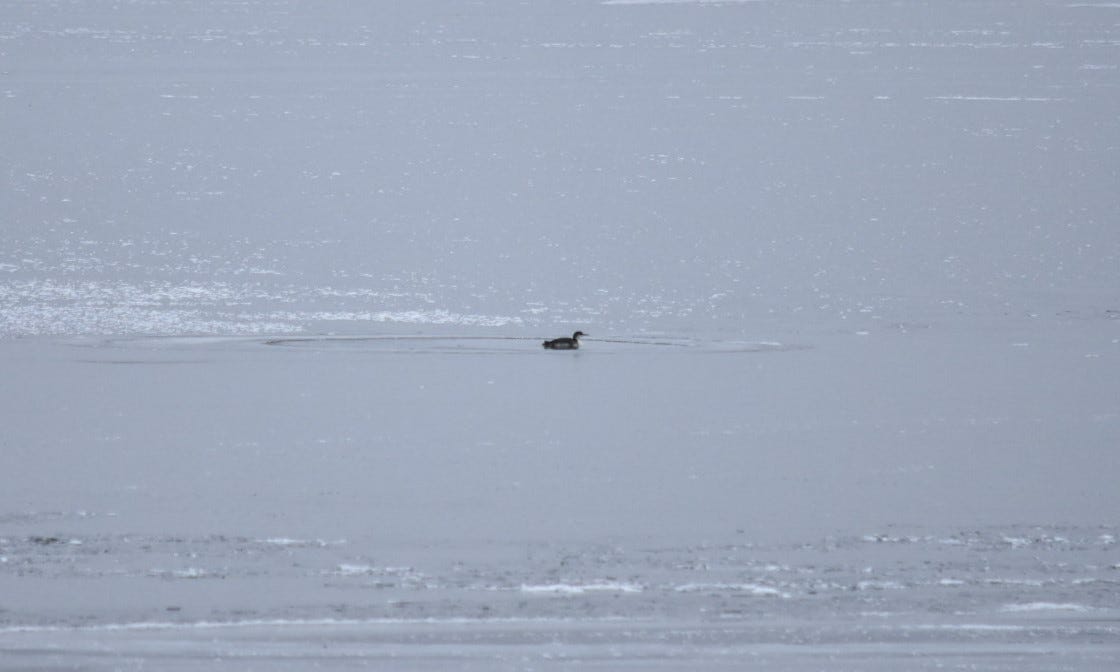
Juvenile common loon “iced in” on Cross Lake, photo by National Loon Center
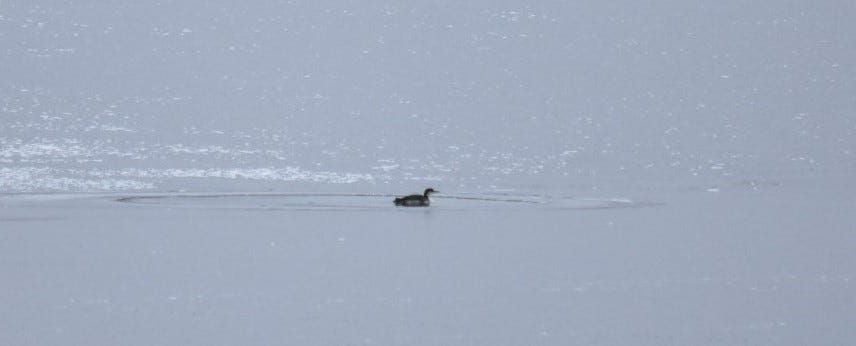
The end of another week at The Nest turned quite eventful with news of a loon in need of rescue. The Friday morning of December 10, the National Loon Center received a concerned call from a local wildlife photographer about what appeared to be an iced-in loon on Cross Lake. Promptly, two NLC staff went to confirm the situation. From the safety of the road, they spotted the bird not far from the shore. It was indeed a juvenile loon and appeared to be in a relatively small pool of open water surrounded by ice. The staff took pictures to report to Minnesota Department of Natural Resources (DNR) conservation officers as well as seek input from experienced rescuers of Loon Rescue in Wisconsin.
Unlike most other birds, loons have dense instead of hollow bones to better dive deep underwater for food. Because of this, they have a relatively heavy body weight compared to their wing size. For a loon to take off from the water they essentially need a “runway,” as an airplane does. This runway is quite long, anywhere from 100–600 feet in length. When a loon remains on the water as winter approaches instead of migrating south towards the Gulf of Mexico it becomes “iced in.” The reason a loon is unable to migrate can be difficult to determine without physically examining the bird. In many cases, it is likely there is some sort of injury preventing the bird from flying. A loon may become injured during aggressive territorial battles with other loons or, tragically, from collisions with boats and other watercraft. There is also the possibility of lead poisoning. When lead jigs and sinkers are lost in the lakes, they sink to the bottom and can be swallowed by loons that use pebbles to grind up the fish they eat. Lead poisoned loons become disoriented and may fly poorly, even crash landing onto the ground. Untreated, the loon will sadly die within two or three weeks.
With all of these factors in mind, a loon rescue yields many unique challenges. The common loon holds a special place in the hearts of many people across the nation. As leaders in loon preservation, the National Loon Center will act as it can to protect this iconic national symbol. In the case of a loon rescue on ice, the situation becomes dangerous quickly and should be done by experienced professionals with specialized equipment.
Careful consideration goes into the decision to rescue a loon. First, the area of water the loon is in must be small enough to safely net the loon without it diving away. Proper equipment is needed to transport the loon without causing additional stress or injury. Rescues and transports can be stressful, albeit necessary, experiences for wildlife. An animal that is injured and under extreme stress can unfortunately die during transport. Thus, the rescue should take place only if a safe capture seems likely and a rehabilitation center has confirmed it can take the loon. Additionally, trained wildlife professionals will examine the bird upon rescue to determine if it is a viable candidate for rehabilitation, or if it should be humanely euthanized.
Volunteer firefighters attempting a loon ice rescue on Cross Lake, photo from Crosslake Fire Department
Common loons are protected under the Migratory Bird Treaty Act of 1918 so rehabbers must have federal permits to admit and treat migratory birds. For the loon on Cross Lake, it was fortunately confirmed that the Wild and Free wildlife rehab center in Garrison, MN could take the loon. Given this confirmation and the relatively small pool of water the loon was in, a rescue seemed plausible. Thinking of the entire path the loon must travel, we also need to consider the likelihood of safe transport all the way to Florida or the Gulf of Mexico for loons that have missed the fall migration window.
The large size of the common loon, its dependence on open water, and its “captive feistiness” make it extremely difficult for them to survive for extended periods under human care. Loons that are weakened due to injury or stress are also susceptible to aspergillosis, a fungus-borne disease that affects the respiratory tract. Dr. Katie Barrato, a veterinarian with Garrison Animal Hospital and Wild and Free, who would treat the loon, has said that loons have been successfully flown to the Gulf before. If an injury is manageable or the levels of lead are low enough to be treated then the loon can be released. Unfortunately, Dr. Barrato stated the winter typically sees a higher number of unreleasable loons as those left behind frequently have a substantial injury preventing them from flying. In the cases of extreme injury, the most humane option can even be to euthanize the bird immediately. Though it is a difficult and sad reality to face, putting a bird through the stress and trauma of medical transport is not worth it if we know that bird cannot overcome its injury.
It is the heavy knowledge of these likelihoods that weighs into the decision to attempt a loon rescue. For a loon with an untreatable injury, the rescue takes it out of the natural food chain it is a part of. However, a loon with lead poisoning left on the lake can become a meal for bald eagles and subsequently poison our national bird. For the loon on Cross Lake the decision was ultimately made to rescue the loon and transport it to Wild and Free. To reiterate, ice rescues are dangerous and should not be attempted by the public. Fortunately, the Crosslake Volunteer Fire Department generously assisted in the rescue.
On Saturday, December 11, Crosslake’s fire chief coordinated an effort to have firefighters dressed in survival suits attempt to rescue the loon as a MN DNR conservation officer and local volunteer offered guidance and support from shore. After about half an hour, the firefighters successfully and safely got the loon into a net then into a suitable container to transport the loon. Loons are strong, heavy birds with sharp bills that make rescues even more tricky. Thankfully, the loon was able to be transported by volunteers to Dr. Barrato at Wild and Free.
MN DNR conservation officer, NLC volunteer, and Crosslake volunteer firefighters, photo from Crosslake Fire Department
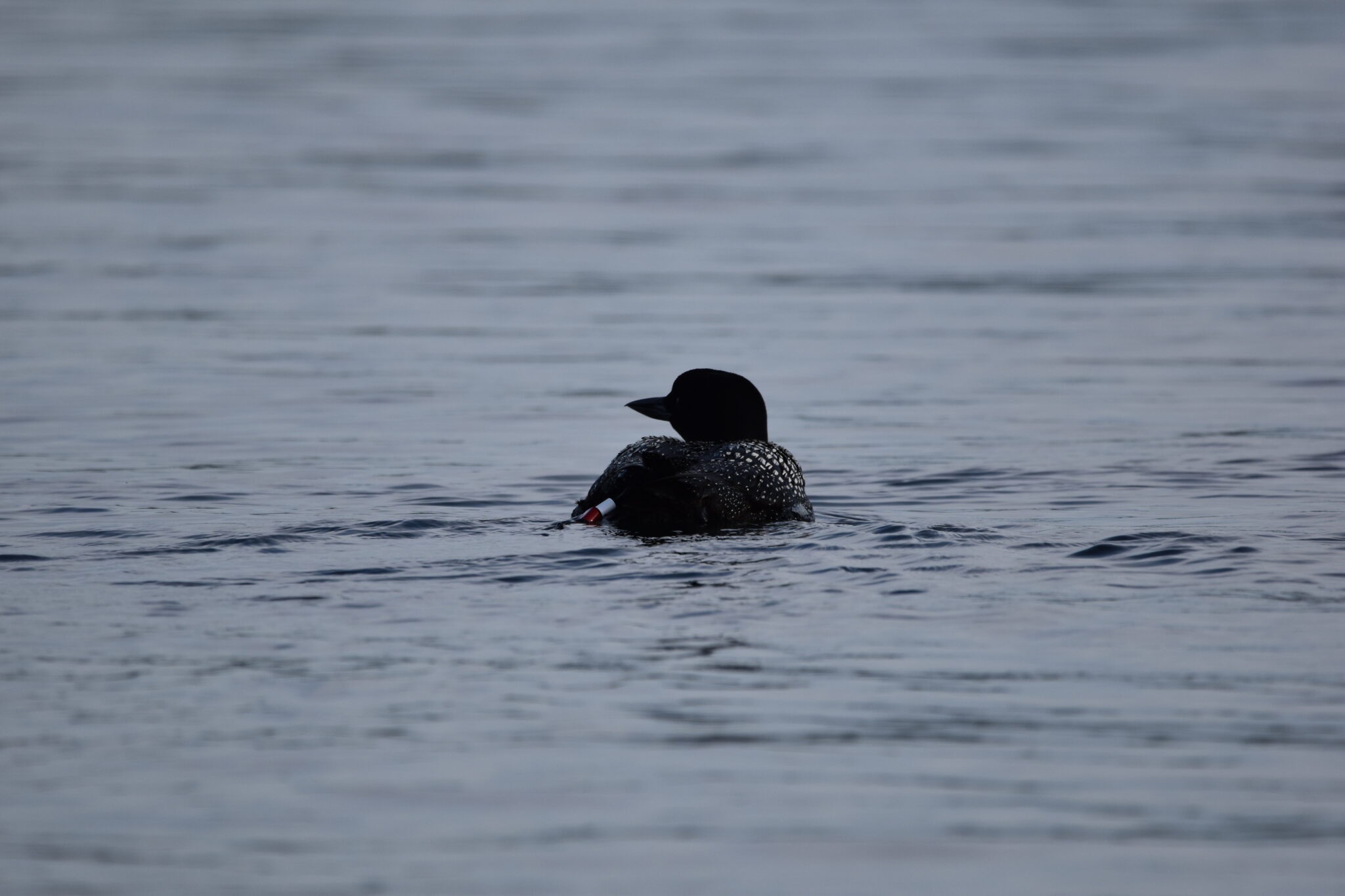
When the loon was pulled out of the water the team immediately noticed the colored bands on its legs. During the 2021 nesting season, the National Loon Center collaborated on a research study of the loon population in Crow Wing County. Non-intrusive colored bands placed on the loons help track individuals throughout their long lives, monitor population dynamics, and estimate annual survival rates. Banding loons is one of many invaluable methods biologists use to study their population and behavioral ecology. Because of the unique set of bands on the loon rescued from Cross Lake we knew this was a male juvenile banded as a chick on the night of July 17th on Rush Lake. According to partner biologists, this male was the biggest juvenile observed in the study this year.
A common loon with color bands on its leg that was banded in the summer of 2021, photo from National Loon Center
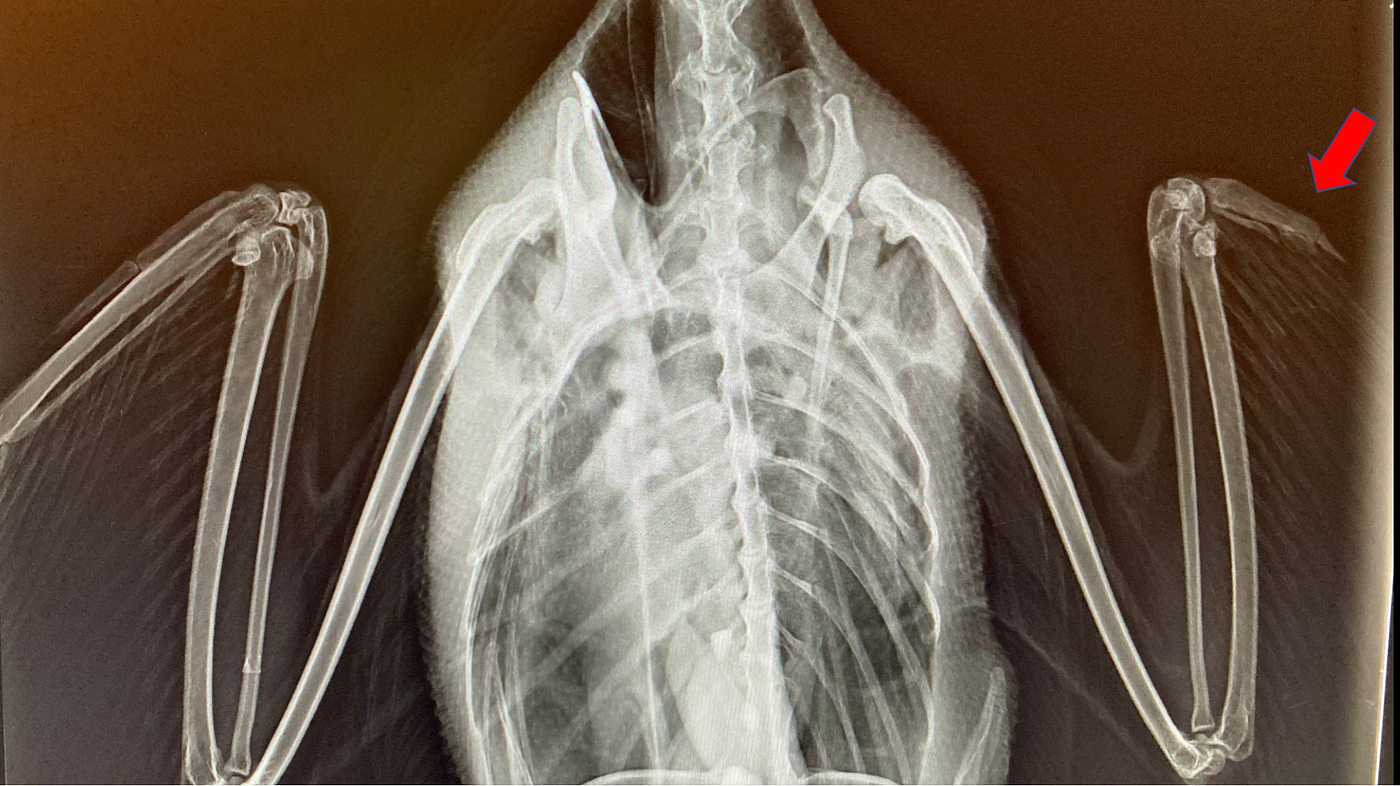
Unfortunately, this loon’s fate was not the happy ending we would have hoped for. Dr. Barrato determined that he had serious, untreatable wing trauma. It appeared the end of his wing was sheared off by a motorboat or jet ski propeller. It’s possible this could have been an old injury from a predator though the nature of the injury seems more likely to be a boat propeller. The loon’s blood was also tested for lead and found not to have a high concentration. Ultimately, without the ability to fly the loon’s survival is unlikely and the most humane outcome for him was determined to be euthanasia. This is a sad loss for the loon population and for all those who marvel at the sight of loons on their lakes.
An x-ray of the loon shows where the wing was likely hit by a boat propeller. The wing is sheared at the metacarpal bone. Photo by Wild and Free rehab center.
The world is a daunting place for young loons. Many of us watch in awe as loon families grace our lakes, feeding and tending to their young. What we don’t always see is the many dangers the vulnerable chicks face from various predators and other threats. Unfortunately, there is a high mortality rate of loons during their first years of life. When they do return to breeding grounds, they may spend two years on average searching for a territory to settle. Territorial battles among male loons can be extremely aggressive, even fatal.
The loon found on Cross Lake seemed to have good prospects of survival as it was the biggest chick banded during the summer and was already fairly independent. Sadly, even if a loon is a good, healthy size to defend itself from predators and other loons, it is no match for a large watercraft. May this be a somber reminder to us that as we recreate on our lakes we must always keep a watchful eye out for the loon families that share these cherished waters.
The National Loon Center is grateful to continue to work with organizations such as Wildlife Rehabilitation & Release and the University of Minnesota Raptor Center’s Partners for Wildlife program as well as DNR permitted wildlife rehabilitators in statewide wildlife rescue efforts.